Introduction
Each and every discussion on artificial intelligence sooner or later circles back to these three words – compute, power, and scale. Yet, each response from the chatbot and training of any model is powered by the same stack of physical components invisible to the average person – a pyramid of infrastructure which needs to function perfectly, layer after layer, until the first token appears.
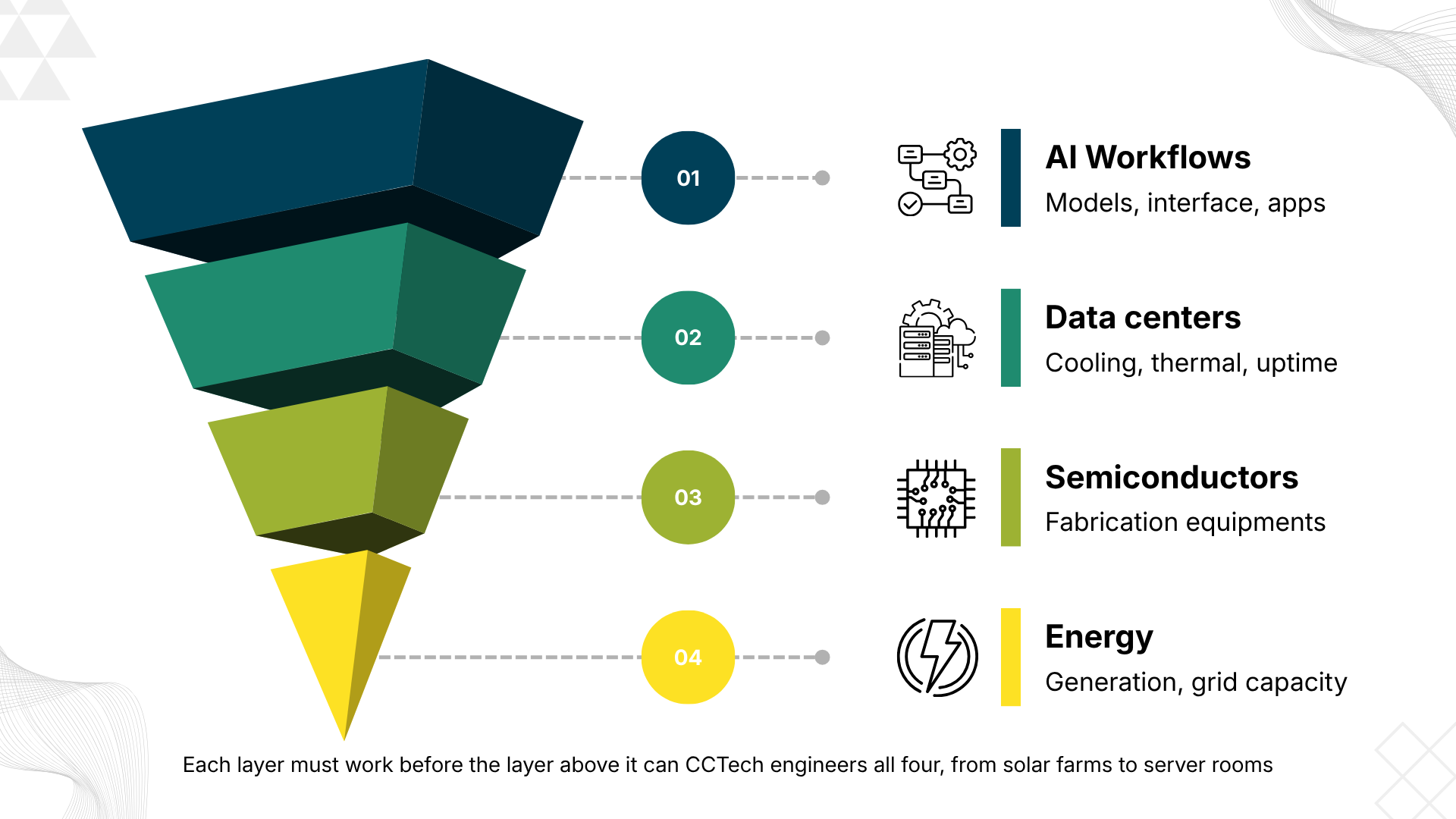
That pyramid of AI could be described as follows: energy at the bottom, semiconductors in the middle, data centres above, and AI workloads on top. Each layer requires flawless functionality of the layers lying beneath. A GPU cannot function without electricity, a data centre will be of no use without cooling, and none of them would exist without chips produced to atomic perfection.
What is often overlooked is who exactly constructs this pyramid to make it functional. This is where CCTech enters the picture – not as a supplier of a particular layer, but as an engineering company that operates in all of these layers.
Layer One: Energy to Support an Energy Hungry AI
The Middle: Chips Without Which No Intelligence Is Possible
The next layer up presents challenges in moving away from energy production to silicon creation. The process of semiconductor manufacturing is likely one of the harshest engineering environments in the world – tolerances in nanometers, non-stop operations, and no room for error.
The collaboration of CCTech with LAM Research, one of the leaders in semiconductor equipment, takes place right in this environment. In this environment, engineering support includes structural and thermal simulation of manufacturing equipment, accurate analysis and design validation for devices that etch and deposit materials at sizes smaller than a virus. Failure at this layer means failure of every single chip going down the line, and the chips that power every single AI data center in the world have already failed by the time they’ve been created.
Engineered intelligence becomes literal at this point – every single AI chip has its intelligence engineered at the manufacturing process level.
Middle-Upper Layer: Non-overheating Data Centers
Chips require accommodation – and increasingly, this is one of the trickiest parts of the pyramid to nail down. AI loads have heat densities that traditional data center design simply wasn’t designed to handle. Full load on a GPU rack can result in thermal density several times greater than in a regular server farm, and airflow issues at this magnitude become throttling or outright equipment failure straight away.
This is when CFD and thermal simulations know-how from CCTech becomes relevant – as far as our clients such as CoolSim are concerned, it is about simulating airflow, heat transfer and cooling systems in data centers prior to designing and tuning these very data centers to operate under actual loads of AI. Fluid dynamics in action solving one of the most vital business problems – preventing overheating and blowing SLAs on power and uptime budget.
And every single hyperscaler and enterprise that’s building AI infrastructure right now is facing this very problem. With CCTech’s simulation capability, their customers have the computational advantage to fix it before it even becomes a problem.
The Top: Where It All Meets
On top of the pyramid lies the actual workload: the models, the inference, the applications everybody knows about. However, with CCTech’s platforms such as SimulationHub and Buildings AI, there is a more general statement to be made: the company is not just providing service for the pyramid, but developing its own AI engineering solutions, which go right on top of the pyramid.
This is an important difference. CCTech is not a simulation software company which has some AI clients. It is an engineering company that knows how the pyramid works since it operates at all levels of the pyramid and uses the strengths of AI to develop engineering tools and the other way around.
Why Cross-Layer Engineering Is Truly What Makes the Difference
Typically, most engineering services providers focus on a particular vertical – whether energy, semiconductor, or facilities. However, CCTech’s approach is somewhat different; the company’s simulation DNA and engineering know-how in CFD and structural engineering get put into practice when it comes to a solar farm, chip fabrication plant, or a data center – because the problems are the same at each layer of the pyramid, but the scale is different.
The difference is significant. Having dealt with thermal management in semiconductor equipment, one will deal with it in data centers. If one has knowledge about structural load for renewable energy infrastructure, the same knowledge will apply to manufacturing equipment design. To CCTech, the pyramid doesn’t represent four different industries; it’s one engineering challenge from four different perspectives.
The Big Picture
The future of AI isn’t determined in technical papers on model architecture alone. It’s determined in solar arrays, semiconductor fabrication facilities, and server rooms in data centers — in the physical engineering that has to happen first in order for anything else to even matter.
CCTech’s involvement in Adani, Waaree, LAM Research, and data center cooling isn’t a random collection of clients. It’s a showcase of what it really takes to engineer the AI stack all the way through — and evidence that those companies which can engineer all layers, not just one, are the ones quietly powering the whole AI industry.